The Vancouver real estate market has always been one of the most closely watched in Canada, and for good reason. With high property values, strong international interest, and ongoing economic shifts, even short-term changes can have a major impact on buyers and sellers alike.So what can we expect in the next three months?This Vancouver real estate forecast 2026 dives into the latest data, trends, and signals shaping the Vancouver housing market next 3 months, and more importantly, what it means for your next move.
Vancouver Real Estate Market Overview Right Now
Before looking ahead, it’s critical to understand where things stand today. The current landscape sets the tone for any meaningful Vancouver property market outlook, especially in a market as sensitive to economic shifts as Vancouver. What we’re seeing right now is not a boom or a crash, but a recalibration. The market is adjusting to higher borrowing costs, shifting buyer expectations, and more balanced supply conditions. This creates a window where both buyers and sellers must be more strategic than they’ve been in years.
Current Home Prices in Vancouver
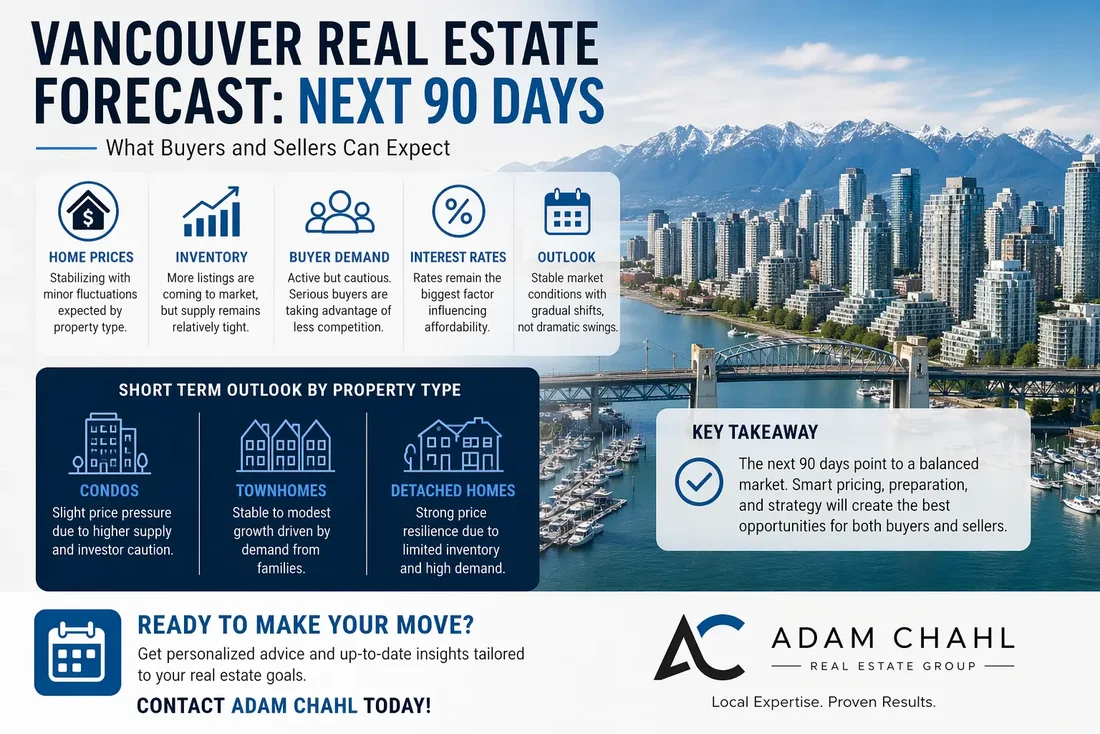
Home prices across Vancouver remain elevated, but the pace of growth has slowed compared to previous years. Instead of rapid appreciation, the market is showing signs of stabilization, particularly in entry-level and condo segments. Detached homes in desirable neighborhoods continue to hold value due to limited supply, while condos and some townhomes are seeing more price sensitivity as inventory grows. Buyers are no longer rushing in with urgency, which is naturally slowing price momentum. For anyone searching for Vancouver home price predictions, this plateau signals a market in transition, not collapse. Prices are no longer driven purely by demand but by affordability, financing conditions, and overall buyer confidence. This shift points toward a healthier and more sustainable market over time.Inventory Levels and Active Listings
Inventory has been gradually increasing, giving buyers more options than they’ve had in recent years. This is a noticeable shift from the highly competitive conditions seen in past cycles. However, supply is still not high enough to dramatically shift the balance of power. Many homeowners are choosing to wait before listing, often holding out for lower interest rates or improved market conditions. This creates a middle-ground market where buyers gain more choice, but sellers are not yet under pressure. Limited inventory continues to support pricing even as demand fluctuates, making this one of the most important factors in current Vancouver real estate market trends.Buyer Demand and Market Activity
Buyer activity is no longer uniform across all segments. Some areas and property types remain active, while others are seeing hesitation, especially among first-time buyers facing affordability constraints. Move-up buyers and downsizers remain active due to existing equity, while investors are becoming more selective, focusing on long-term value instead of quick returns. This creates a more thoughtful and less speculative market environment. As a result, well-priced properties are still selling relatively quickly, while overpriced listings are staying on the market longer. This shift in behavior is a defining characteristic of current Vancouver real estate market trends.Interest Rates and Financing Conditions
Interest rates continue to play a central role in shaping the market. Even small increases can significantly reduce affordability, especially in a high-priced market like Vancouver. Higher borrowing costs limit how much buyers can spend, which affects overall demand and price growth. Buyers are adjusting their expectations, often looking at lower price points or different property types. The Vancouver interest rate impact on real estate dynamics is clear: when rates rise, demand slows, and when rates stabilize or decrease, activity tends to recover. Over the next 90 days, this will remain one of the most influential factors in market performance.What Will Happen to Vancouver Home Prices in the Next 90 Days
Now to the question everyone is asking: Is the Vancouver housing market going up or down? The reality is more balanced than extreme. The market is likely to move gradually rather than experience sharp increases or declines.Will Prices Rise, Stall, or Decline
Over the next three months, the most likely outcome is price stability with minor fluctuations depending on property type and location. Seasonal trends may also support short-term activity as more buyers enter the market. This short-term Vancouver housing forecast suggests detached homes will likely maintain value due to limited supply, condos may see slight price adjustments due to increased inventory, and townhomes will remain competitive due to consistent demand from families. Overall, the market is expected to move slowly and steadily rather than dramatically.Key Factors Driving Price Movement
Several interconnected factors will influence price direction over the coming months. Interest rates remain the most significant, as they directly affect affordability and buyer capacity. Seasonal demand patterns can temporarily increase activity, while broader economic confidence impacts willingness to make large financial decisions. Inventory levels also play a critical role in determining how competitive the market becomes. Together, these elements shape Vancouver home price predictions and must be considered collectively rather than individually.Short-Term Price Predictions by Property Type
Condos may face slight downward pressure or remain flat due to increased supply and cautious investor activity. However, desirable units in strong locations will continue to perform well. Townhomes are expected to remain stable or experience modest growth due to ongoing demand from buyers seeking more space without the price of detached homes. Detached homes will likely show the strongest resilience due to ongoing supply limitations, making them more insulated from short-term fluctuations in the Vancouver housing market over the next 3 months.Vancouver Housing Supply and Inventory Trends
Supply remains one of the most important drivers of market conditions and pricing direction.
Supply remains one of the most important drivers of market conditions and pricing direction.
Are More Listings Entering the Market
More listings are entering the market, but at a gradual pace. There is no sudden surge in supply, as many sellers are still waiting for more favorable conditions. Some homeowners are hesitant due to uncertainty around interest rates, while others are holding onto properties as long-term investments. This measured increase in supply prevents sudden shifts in pricing.
More listings are entering the market, but at a gradual pace. There is no sudden surge in supply, as many sellers are still waiting for more favorable conditions. Some homeowners are hesitant due to uncertainty around interest rates, while others are holding onto properties as long-term investments. This measured increase in supply prevents sudden shifts in pricing.
Seller Behavior in a Shifting Market
Sellers are becoming more strategic and informed. The approach of overpricing and expecting multiple offers is no longer as effective. Instead, sellers are focusing on accurate pricing, strong presentation, and competitive positioning. Homes that are priced correctly tend to attract more attention and sell faster. This change reflects the evolving Vancouver real estate forecast 2026, where strategy and preparation are more important than timing alone.
Sellers are becoming more strategic and informed. The approach of overpricing and expecting multiple offers is no longer as effective. Instead, sellers are focusing on accurate pricing, strong presentation, and competitive positioning. Homes that are priced correctly tend to attract more attention and sell faster. This change reflects the evolving Vancouver real estate forecast 2026, where strategy and preparation are more important than timing alone.
What Low or High Inventory Means for Prices
Inventory levels have a direct impact on price movement. When inventory is low, prices tend to remain strong due to limited competition among sellers. As inventory rises, buyers gain more negotiating power, which can slow price growth or lead to minor price adjustments. Vancouver is currently in a balanced position, where small shifts in inventory can influence market direction quickly.
Inventory levels have a direct impact on price movement. When inventory is low, prices tend to remain strong due to limited competition among sellers. As inventory rises, buyers gain more negotiating power, which can slow price growth or lead to minor price adjustments. Vancouver is currently in a balanced position, where small shifts in inventory can influence market direction quickly.
Buyer Demand and Behavior Over the Next 3 Months
Buyer psychology is a key factor in understanding how the market will behave in the short term.
Buyer psychology is a key factor in understanding how the market will behave in the short term.
Are Buyers Waiting or Taking Action
Many buyers are taking a cautious approach, closely watching interest rates and market conditions before making decisions. They are waiting for clearer signals such as rate reductions, price adjustments, or increased inventory. At the same time, serious buyers with stable financial positions continue to act, taking advantage of reduced competition and better negotiating opportunities.
Many buyers are taking a cautious approach, closely watching interest rates and market conditions before making decisions. They are waiting for clearer signals such as rate reductions, price adjustments, or increased inventory. At the same time, serious buyers with stable financial positions continue to act, taking advantage of reduced competition and better negotiating opportunities.
First-Time Buyers vs Investors
First-time buyers are facing affordability challenges and stricter lending requirements, making them more cautious in their approach. Many are adjusting expectations by considering smaller homes or different locations. Investors are shifting toward long-term strategies, focusing on rental demand and property fundamentals rather than short-term appreciation. This contributes to a more stable and less speculative market environment. This evolution is shaping current Vancouver real estate market trends.
First-time buyers are facing affordability challenges and stricter lending requirements, making them more cautious in their approach. Many are adjusting expectations by considering smaller homes or different locations. Investors are shifting toward long-term strategies, focusing on rental demand and property fundamentals rather than short-term appreciation. This contributes to a more stable and less speculative market environment. This evolution is shaping current Vancouver real estate market trends.
How Interest Rates Are Affecting Decisions
Interest rates influence nearly every aspect of the buying process. They determine how much buyers can afford, impact mortgage approvals, and shape overall confidence. As a result, monitoring the Vancouver interest rates' impact on real estate will be critical over the next 90 days, as even minor changes can significantly alter buyer behavior.
Interest rates influence nearly every aspect of the buying process. They determine how much buyers can afford, impact mortgage approvals, and shape overall confidence. As a result, monitoring the Vancouver interest rates' impact on real estate will be critical over the next 90 days, as even minor changes can significantly alter buyer behavior.
What This Means for Buyers in Vancouver
If you are considering buying a home in Vancouver in 2026, current conditions may present unique opportunities.
If you are considering buying a home in Vancouver in 2026, current conditions may present unique opportunities.
Is Now a Good Time to Buy
While timing depends on individual circumstances, the current market offers several advantages. Buyers face less competition, have access to more listings, and are not under the same pressure to act quickly. This allows for more thoughtful decision-making and better negotiation opportunities.
While timing depends on individual circumstances, the current market offers several advantages. Buyers face less competition, have access to more listings, and are not under the same pressure to act quickly. This allows for more thoughtful decision-making and better negotiation opportunities.
Opportunities Buyers Should Watch
Buyers should focus on properties that have been on the market longer, listings with price adjustments, and situations where sellers are motivated. These scenarios are becoming more common in the Vancouver housing market in the next 3 months and can offer strong value.
Buyers should focus on properties that have been on the market longer, listings with price adjustments, and situations where sellers are motivated. These scenarios are becoming more common in the Vancouver housing market in the next 3 months and can offer strong value.
Mistakes Buyers Must Avoid in This Market
Waiting too long for a perfect deal, ignoring financing realities, or skipping due diligence can lead to missed opportunities or costly mistakes. Successful buyers remain informed, prepared, and ready to act when the right opportunity arises.
Waiting too long for a perfect deal, ignoring financing realities, or skipping due diligence can lead to missed opportunities or costly mistakes. Successful buyers remain informed, prepared, and ready to act when the right opportunity arises.
What This Means for Sellers in Vancouver
Understanding selling a home in Vancouver market trends is essential for achieving the best possible outcome.
Understanding selling a home in Vancouver market trends is essential for achieving the best possible outcome.
Should You Sell Now or Wait
Selling now can be a good decision if the property is priced correctly and presented well. Waiting for better conditions does not guarantee higher prices, especially in a stable market.
Selling now can be a good decision if the property is priced correctly and presented well. Waiting for better conditions does not guarantee higher prices, especially in a stable market.
Pricing Strategy in a Changing Market
Accurate pricing is more important than ever. Overpriced homes tend to sit on the market, while well-priced properties attract more interest and stronger offers. A thoughtful pricing strategy is critical in today’s Vancouver property market outlook.
Accurate pricing is more important than ever. Overpriced homes tend to sit on the market, while well-priced properties attract more interest and stronger offers. A thoughtful pricing strategy is critical in today’s Vancouver property market outlook.
How to Attract Serious Buyers Fast
Sellers should focus on presentation, marketing quality, and flexibility. Well-prepared homes that are easy to show and priced appropriately tend to perform best.
Sellers should focus on presentation, marketing quality, and flexibility. Well-prepared homes that are easy to show and priced appropriately tend to perform best.
Key Signals to Watch Over the Next 90 Days
Tracking the right indicators can provide valuable insights into where the market is heading.
Tracking the right indicators can provide valuable insights into where the market is heading.
Interest Rate Announcements
Changes in interest rates will directly influence affordability and buyer demand.
Changes in interest rates will directly influence affordability and buyer demand.
Monthly Sales Volume Reports
Sales activity indicates whether the market is strengthening or slowing.
Sales activity indicates whether the market is strengthening or slowing.
New Listings vs Sold Listings Ratio
This ratio helps determine whether buyers or sellers currently have the advantage.
This ratio helps determine whether buyers or sellers currently have the advantage.
Days on Market Trends
Longer selling times often signal softer demand, while shorter timelines indicate stronger competition.
Longer selling times often signal softer demand, while shorter timelines indicate stronger competition.
Vancouver Real Estate Forecast Summary
The next three months are expected to bring stability rather than dramatic change.
The next three months are expected to bring stability rather than dramatic change.
Best Case Scenario
Interest rates stabilize or decrease, buyer confidence improves, and prices see modest growth.
Interest rates stabilize or decrease, buyer confidence improves, and prices see modest growth.
Worst Case Scenario
Rates increase, demand weakens, and prices soften slightly.
Rates increase, demand weakens, and prices soften slightly.
Most Likely Outcome
Stable prices, balanced conditions, and gradual shifts define the most realistic Vancouver home price predictions.
Stable prices, balanced conditions, and gradual shifts define the most realistic Vancouver home price predictions.
Final Thoughts: How to Navigate the Next 90 Days
The upcoming months will reward preparation and strategy rather than speculation.
The upcoming months will reward preparation and strategy rather than speculation.
Strategy for Buyers
Buyers should secure financing, monitor the market closely, and act when opportunities arise.
Buyers should secure financing, monitor the market closely, and act when opportunities arise.
Strategy for Sellers
Sellers should price competitively, invest in presentation, and remain open to negotiation.
Sellers should price competitively, invest in presentation, and remain open to negotiation.
Why Timing Matters More Than Ever
Timing is no longer about predicting peaks or bottoms. It is about being ready to act when the right opportunity appears. The short-term Vancouver housing forecast highlights a market where informed and prepared participants benefit most.The Vancouver real estate forecast for 2026 for the next 90 days points toward a balanced, transitional market. While uncertainty remains around interest rates and economic conditions, one thing is clear: both buyers and sellers have opportunities if they approach the market strategically. Whether you're entering the market or planning your next move, understanding the Vancouver housing market over the next 3 months could be the difference between a missed opportunity and a smart investment.
Timing is no longer about predicting peaks or bottoms. It is about being ready to act when the right opportunity appears. The short-term Vancouver housing forecast highlights a market where informed and prepared participants benefit most.