 Homeowners who took 5-year mortgages in 2021–22 are now facing “mortgage renewal shock” as those rock-bottom rates give way to today’s much higher rates. In early 2021, 5‑year fixed rates dipped to ~1.4% and 5‑year variable rates to 0.99%. By 2026, the best 5-year fixed offers are roughly 4.0–4.5% (about 2.5 pt higher) and 5-year variable around 3.35–4.0%. This sharp rise has already prompted 1.5 million Canadian households to renew at higher rates in 2025, with another million up for renewal soon. In practical terms, most borrowers coming up for renewal in 2026 will see significantly higher interest rates on their new mortgage term.
 This blog examines why mortgage renewal payments are climbing, how much they might jump, and whether you should lock in a fixed rate or choose a variable. We draw on official data and expert analysis (BoC, CMHC, RBC, TD, etc.) to give homeowners the context and advice they need.
Why Mortgage Renewals Are Different in 2026
The renewal wave in 2026 is unprecedented because many mortgages were issued at extraordinarily low rates. During the COVID lockdowns, the Bank of Canada cut its policy rate to near zero, and lenders passed on record-low rates to borrowers. Since then, inflation has surged. To fight it, the BoC hiked its overnight rate to 5% by mid-2023 and now holds it at 2.25%. However, fixed mortgage rates are tied to bond yields, which have stayed elevated due to inflation and geopolitical risks. As a result, current 5-year fixed mortgage offers (around 4.0–4.6% at top lenders) are about 2.5 percentage points higher than in early 2021. Variable rates (tied to Prime) have also risen – Prime is now ~4.45%, making typical advertised variable rates ~4.0–4.5%. In short, the “renewal interest rate environment” in 2026 is far more expensive than the pandemic era.This shift means 5-year terms signed in 2021 (when rates were ~1–2%) will reset at ~4–5% in 2026, a huge jump for many borrowers. Bank of Canada data confirm this: about 60% of mortgages renewing in 2025–26 (mostly 5-year fixed) will face higher payments. CMHC reports that over half of these borrowers have already felt the pain of renewing at higher rates. In contrast, many borrowers on variable or short-term loans have already absorbed most hikes.
Key factors setting 2026 apart:
- Policy stance: BoC’s recent decisions (e.g., April 2026 hold at 2.25%) aim to watch inflation (boosted by oil prices) stabilize. The BoC’s forecast is that inflation will fall back toward 2% by 2027, implying policy rates could remain on hold for a while.
- Market expectations: Most analysts do not expect a big cut in 2026. In fact, with global trade tensions and oil shocks, many forecasters now see the next move as rate hikes. Scotiabank, for example, even predicts several rate increases in late 2026. Mortgage writers advise borrowers to assume the era of declining rates may be over, meaning current mortgage rates may not fall much further.
- Borrower mix: The mortgage market has tilted toward variable/short-term loans (now ~73% of the stock). This means policy rate cuts would flow through faster to many borrowers than the prior hikes did. TD Economics notes that by late 2026 a growing share of renewals will actually be into lower rates, moderating aggregate payment increases. In other words, after a period of steep hikes, the “renewal shock” should ease.
How Much Could Your Mortgage Payment Increase at Renewal?
The jump in your monthly payment at renewal depends on your original rate, remaining balance and term, and the new rate. Bank of Canada projections suggest that on average mortgage payments for renewals will rise ~6% in 2026 (after a ~10% jump in 2025). But this average masks wide swings: holders of 5‑year fixed mortgages typically face the largest increase, while variable-rate holders may see payments hold steady or even fall. For example, BoC simulation found that 5-year fixed holders renewing in 2026 could see payments ~20% higher on average, whereas those with variable-rate mortgages might see payments 5–7% lower (since their rate is already high).Ratehub’s April 2026 analysis provides concrete examples. They assume a $537,313 balance (a typical loan size) and compute that at 5-year fixed rates moving from 1.39% to 4.04%, the monthly payment jumps by about $622 (24%). A sample calculation: a $500,000, 25-year mortgage locked at 1.5% has a payment of about $2,000; if renewed at 5.0%, the payment would become ~$2,923 (a +46% increase). By contrast, if that same $500,000 started at 1.0% (variable) and renewed at 4.0%, the payment goes from ~$1,884 to ~$2,639 (+40%). These illustrative numbers show how steep the increase can be. The exact jump will depend on your amortization and how much principal is left. In practice, BoC found that ~60% of renewals see an increase at all, but about 25% will actually see smaller payments (mostly variable borrowers).
What Is Mortgage Payment “Shock”?
“Mortgage payment shock” refers to a sudden spike in monthly mortgage costs when a low-rate loan resets to a higher rate at renewal. It became a popular term in Canada during this renewal wave. As TD Economics explains, the concern has been that “mortgages originated at rock-bottom pandemic rates” would renew at much higher prevailing rates. This shock can strain budgets: CMHC notes that for many households renewing in 2025, “the pressure on budgets has been significant."In many cases, borrowers who were enjoying historically low payments suddenly see hundreds of dollars added to their monthly mortgage. The BoC and others compare this to hitting a financial “cliff.” The result has been lower consumer spending and tighter finances in regions where renewals are concentrated. TD reports that, despite the shock, Canadian households have so far weathered it (thanks to rising incomes and longer amortizations). Still, for individual homeowners, the impact is real: a fixed-rate borrower going from 2% to 4.5% on a $300k loan will owe much more each month, which is the essence of the renewal shock phenomenon.
Fixed-Rate vs. Variable-Rate Mortgages
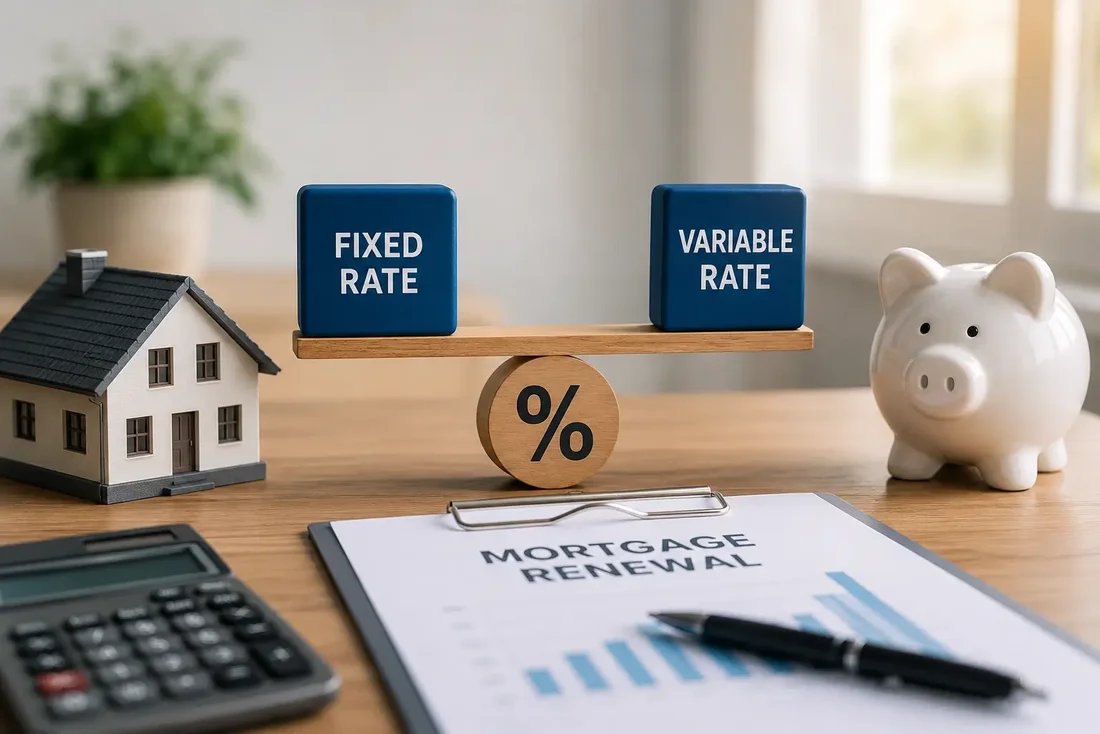
When it’s time to renew, borrowers must choose an interest type for the new term. Fixed-rate mortgages lock in one interest rate for the entire term (often 5 years). Variable-rate mortgages (often called adjustable-rate mortgages) have rates that move with Prime or a short-term lender index. Each has pros and cons:- Fixed-Rate Benefits: You get budget certainty—your interest rate and payments won’t change for the term, protecting you if rates rise. As RBC explains, if the policy rate goes up, fixed borrowers aren’t affected until their renewal. This stability is ideal if you are risk-averse or need payment predictability. A fixed rate also fixes the amortization schedule (you know exactly when the loan will end). On the downside, fixed rates are generally higher than initial variable rates, and you give up any benefit if rates fall. If you break a fixed mortgage early, penalties are usually larger than for a variable one (so consider portability or staying the full term).
- Variable Rate Benefits: Initial rates are typically lower than fixed. For example, before recent volatility a 5-year variable might run ~0.5–0.8% below a comparable fixed rate. This means lower initial payments. If the bank cuts rates, variable borrowers see immediate savings (RBC notes that a rate cut lowers your interest portion while keeping payments the same, speeding up principal payoff). Additionally, many variable plans allow you to switch to fixed later (often with smaller penalties) or to re-amortize when rates fall. Over the long run, variable rates have historically saved homeowners money on interest. The trade-off is risk: if interest rates climb, your payments can grow (though some variable plans let you keep payments flat and extend amortization).
Benefits of Fixed Rates
- Payment Certainty: Your monthly mortgage payment stays the same (great for budgeting). You won’t be surprised by rate spikes during your term.
- Stability: Locking in today’s rate insulates you if inflation or geopolitical shocks force the central bank to raise rates further. Experts often counsel risk-averse borrowers to fix rates in uncertain times.
- Amortization Security: You pay off your mortgage on schedule, as fixed rates guarantee a constant amortization plan.
- Refinancing Rate Lock: If bond yields are projected up, fixing now means you avoid later increases in 5-year fixed offers. For instance, BoC’s April 2026 statement warns that higher energy prices could make them hike rates if needed—a risk fixed borrowers can sidestep.
Benefits of Variable Rates
- Lower Starting Rate: You often begin at a lower rate (and payment) than with a fixed mortgage. True North Mortgage notes that a 5-year variable is usually lower than a 5-year fixed.
- Savings on Rate Drops: If interest rates fall or stay put, you save on interest. RBC explains that when the bank cuts, a variable mortgage either lowers your payment or lets you shorten your amortization without changing payments. Those savings accumulate.
- Flexibility: Variable mortgages often let you switch to fixed at any time with modest fees, giving you options mid-term. Break penalties on variable mortgages are usually lower too.
- Re-Amortization: Some lenders let you apply additional payments toward principal or shorten your amortization when rates fall. This means any rate relief quickly improves equity or shortens your loan.
Should You Lock In a Fixed Mortgage Rate in 2026?
Many homeowners ask, “Should I lock in my mortgage at renewal or stay variable?" The answer hinges on your financial situation and market expectations. If you need budget certainty or worry rates will climb with inflation or global risks, fixing now can be prudent. For example, Ratehub warns that 2026 mortgage rates are unlikely to fall further and recommends securing today’s rate with a hold or pre-approval. Likewise, banks like RBC offer options (e.g., a 120-day early-renewal lock) to let you lock in the current rate well before your renewal date.Locking in means your payment is fixed and you’re protected if bond yields continue upward. On the other hand, keep in mind: if the BoC does cut rates soon, fixed-rate borrowers miss out on savings. At renewal, you often have an opportunity to switch lenders or renegotiate, so don’t feel obligated to take your first offer. In practice, many lenders send a renewal letter ~3 months ahead, resist signing it without review, as RBC notes, once you sign, the new rate is fixed even if your renewal date is weeks away.
In short, lock in fixed if you value stability and worry about future rate hikes. Use an early renewal feature or rate-hold if available (RBC’s 120-day guarantee is one example). Consider locking once you have a competitive offer in hand.
When a Variable Rate Mortgage May Be the Better Choice
A variable-rate renewal can be smart if you’re comfortable with some risk or expect rates to stabilize (or even fall) in the near term. TD Economics notes that as of 2026, a growing majority of mortgages are variable or short-term, meaning future policy cuts would rapidly benefit many borrowers. If inflation cools faster than feared, the BoC could cut rates (most forecasters only see cuts in 2027, but surprises can happen). In that scenario, a variable borrower would enjoy lower payments sooner than a fixed-rate holder.Variable renewals can also make sense if your cash flow is tight now. Since variables usually offer a lower initial rate, your payments might remain more affordable immediately after renewal than the fixed alternative. Additionally, if you plan to pay off your mortgage aggressively or make lump-sum payments, a variable’s flexibility (easier conversion to fixed and lower penalties) can be beneficial.However, going variable means accepting uncertainty: if the economy heats up, the BoC could unexpectedly raise the policy rate again. Before choosing a variable, consider whether you could handle a higher payment. Using a mortgage payment calculator is wise – it lets you plug in higher rates to see the impact. For example, our website’s renewal calculator tool can compare outcomes under fixed vs. variable scenarios, helping you decide.
Strategies to Reduce the Impact of Higher Mortgage Payments
If you face a higher renewal rate, you have options to ease the burden:- Shop Around: Don’t default to your current lender’s rate. Compare offers from banks and brokers. A switch at renewal incurs no penalty, and even a 0.25% rate cut could save you hundreds.
- Consider Blending or Refinancing: Some lenders may blend your old rate with a new rate for part of your mortgage, smoothing the increase. Alternatively, use renewal as an opportunity to refinance (e.g., into a 5-year fixed at your current rate plus a small penalty).
- Extend Amortization: If approved, adding a few years to your amortization spreads the balance over more payments. This lowers your monthly due, though it slightly raises total interest costs over time. Even a 5-year extension can significantly reduce monthly payment.
- Make Lump-Sum Prepayments: Use any cash (savings bonus, tax refund, etc.) to pay down principal before renewal. A lower principal means the higher rate applies to a smaller balance, blunting the payment jump.
- Lock in Early: If rates are on the rise, use an early renewal or rate hold (many lenders allow locking in your renewal rate 90–120 days in advance). This freezes today’s rate for your renewal date, protecting you if rates climb further.
- Use a Mortgage Broker or Advisor: A broker can alert you to special deals (like cash-back offers) and help negotiate. They can also help you run numbers (using tools like a mortgage payment calculator) and stress-test your budget against different scenarios.
- Ask for a Shorter Term: You’re not obliged to pick a 5-year term again. A 3-year or 2-year fixed mortgage might have a lower rate. This lets you renew sooner, possibly at a better rate if the market improves.
Questions to Ask Before Renewing Your Mortgage
Before signing, make sure to clarify all options and details. Key questions include the following:- What rate am I currently paying, and what rate are you offering me now? Gather several quotes.
- Should I renew with my current lender or shop around? Compare both scenarios. (Tip: If switching, be ready to qualify under today’s rules, including a stress test.)
- Can I lock in the current rate or get a rate hold? Ask about early renewal options (e.g., RBC’s 120-day lock).
- Are there any renewal fees or penalties? Usually, renewing with the same lender at term-end has no fee, but check if a refinance or breaking the term does. RBC notes that staying with them requires no requalification.
- What amortization will I have after renewal? If your amortization is short (say 15 years), you might extend it to lower payments.
- Should I adjust my mortgage strategy? (e.g., add payment frequency, switch to fixed-payment variable, or make a lump payment).
- What happens if I sign the renewal letter early? (RBC warns signing too soon can lock you into a new rate before your term actually ends.)
Common Mortgage Renewal Mistakes to Avoid
When renewing, avoid these pitfalls:- Don’t Just Accept the First Offer: Many borrowers sign the renewal form from their bank without comparing rates. This “set-and-forget” approach often leaves money on the table. Instead, negotiate your rate or take offers from a mortgage broker.
- Don’t Sign Too Early: As noted, signing the renewal letter immediately implements the new rate. If your renewal date is months away, signing early could bind you to a higher rate sooner. Wait until you’re ready.
- Ignoring the Fine Print: Check if switching lenders requires a new qualification or if porting is needed (when moving homes).
- Focusing Only on Interest Rates: Remember to consider amortization and payment flexibility. A slightly higher rate might be worth it if the lender lets you shorten amortization or offers better prepayment privileges.
- Failing to Use Calculators: Many miss the simple step of crunching numbers. A “mortgage payment calculator” can show you exactly how different rates and terms affect your payments. Skipping this analysis can lead to surprises in your budget.
- Neglecting Your Budget: Don’t assume your income or expenses can absorb the increase. Re-run your household budget with the higher payment and plan ahead (e.g., reduce other spending or increase income if needed).
What Experts Expect for Mortgage Rates in the Near Future
Looking ahead, the consensus is that rates are likely near their peak in the short term. The Bank of Canada’s April 2026 press release kept the overnight rate at 2.25%, citing oil-price-driven inflation around 3% and expecting it to return to 2% by 2027. The BoC says it will look through temporary shocks (like higher gas prices) but “stand ready to respond as needed."Financial analysts generally predict no more cuts in 2026. Many (Scotiabank, TD, and National Bank) see the BoC holding rates steady or even raising them if inflation stays stubborn. For example, the Mortgage Sandbox forecast (based on major banks’ outlooks) notes that the risk to policy rates is actually skewed upward. This means current mortgage rates, especially fixed rates, are unlikely to drop soon. Mortgage bond yields (which set fixed rates) are expected to stay in the 3.0–3.5% range throughout 2026, translating to 5-year fixed offers around 4.5–4.9% by year-end. Some house price scenarios (if a recession hit) could push them back down near 4.0%, but that is not the base case.In contrast, variable rates mirror the policy rate: with the BoC likely on hold, variable rates should remain near Prime (≈4.45%). Mortgage Sandbox concludes that Canada is “at or near the bottom” of this cycle, making cuts unlikely absent a sharp downturn. In short, most experts advise borrowers to assume rates stay roughly where they are in 2026.Bottom line: Plan for mortgage rates to remain high through most of 2026. Fixing now means you lock in current levels. If you go variable, expect to benefit only if the BoC starts cutting in 2027. Stay informed via central bank announcements and economic news – but don’t count on big rate relief any time soon.
Conclusion
The 2026 mortgage renewal wave is a critical juncture for many homeowners. With about 60% of mortgages renewing and most at much higher rates than they started, millions of Canadians are asking if their payments will soar. The answer is many will increase, especially fixed-rate borrowers. Official data warn of average payment hikes in the mid-single digits, but sharp double-digit jumps are common for renewers of 5-year fixed loans.Given this reality, the best approach is preparation. Don’t panic: know your options. Use mortgage payment calculators (like on our website) to see how different scenarios affect you. Compare fixed vs. variable terms in light of your tolerance for risk. Shop around and ask lenders tough questions. Consider extending amortization or making extra payments if needed.
Ready to Renew Your Mortgage? Get Expert Advice Before You Sign
Mortgage renewal is one of the most important financial decisions homeowners make. A small difference in interest rates or mortgage terms can have a significant impact on your monthly payments and long-term financial goals.Before accepting your lender's first renewal offer, take the time to explore your options. Whether you are considering a fixed rate for stability or a variable rate for potential savings, professional guidance can help you make a confident and informed decision.
If you are planning to renew your mortgage, refinance, buy a home, or explore investment opportunities, connect with Adam Chahl and the team at Vancouver Home Search. They can help you understand today's mortgage market, evaluate your options, and find a strategy that fits your financial goals.
Visit Vancouver Home Search or contact Adam Chahl directly at +1 (778) 385-6141 to discuss your mortgage and real estate needs. A quick conversation today could help you save thousands over the life of your mortgage.
Frequently Asked Questions (FAQs)
- Will my mortgage payment definitely increase at renewal? Not necessarily. It depends on your current rate type. Fixed-rate borrowers renewing from pandemic-era rates will likely see higher payments. However, variable-rate renewals may have smaller changes or even slight declines. Use a calculator to estimate your specific scenario.
- Should I lock in a fixed mortgage rate or stay variable? That depends on your situation. If you need stability or expect rates to rise, a fixed rate might suit you. If you can handle some variability and think rates may fall, a variable could save you money. Weigh the pros and cons (see above) and consider current forecasts; many experts suggest rates are unlikely to drop in 2026.
- What mortgage renewal options are available for homeowners? You can renew with your current lender or switch to a new one. At renewal you can also change term length (e.g., 5-year to 3-year), extend amortization, or make lump-sum payments. Each option has trade-offs (e.g., longer amortization lowers payment but increases total interest). Our mortgage renewal advice page outlines these choices in detail.
- How can I estimate my new mortgage payment at renewal? Use a mortgage payment calculator. Input your remaining balance, new interest rate, and amortization to see the payment. Many banks and government sites (e.g., CMHC) offer such calculators. Our mortgage payment calculator renewal tool is specifically designed to compare your current and new payment under different rates.
- Are rising mortgage rates in Canada expected to fall soon? Most forecasts say no major cuts are likely in 2026. Inflation trends and global uncertainty suggest the BoC will hold or even raise rates if needed. Therefore, plan as if rates will stay high. However, keep an eye on Bank of Canada announcements (next decision dates are listed on our site)—any official change would directly affect variable rates and influence fixed rates over time.