 Squamish (population around 24,000) has rapidly grown over the past decade as an outdoor-oriented community about 45 minutes north of Vancouver. Its real estate market is tight, with average detached home values around C$1.39 million and an early 2026 benchmark home price near C$1.12 million.
Prices are highest in Garibaldi Highlands, where houses can exceed $2.2 million, while downtown condos average closer to $680,000. The cost of living is high by Canadian standards, with one-bedroom apartments renting for around C$2,100 to C$2,300 per month and utilities averaging about C$166 monthly.
Lifestyle is the main draw. Squamish is widely known as Canada’s Outdoor Recreation Capital and offers world-class hiking trails, rock climbing on the Stawamus Chief, windsurfing, mountain biking, and a growing brewery and arts scene.
The town includes strong amenities, including public schools, a Capilano University campus, and expanding commercial areas. Many residents commute to Vancouver, which can take roughly 60 to 90 minutes via the Sea to Sky Highway.
In short, Squamish offers a family-friendly community and an exceptional outdoor lifestyle, though higher housing costs and commuting times are important considerations.
Where Is Squamish, BC, Located?
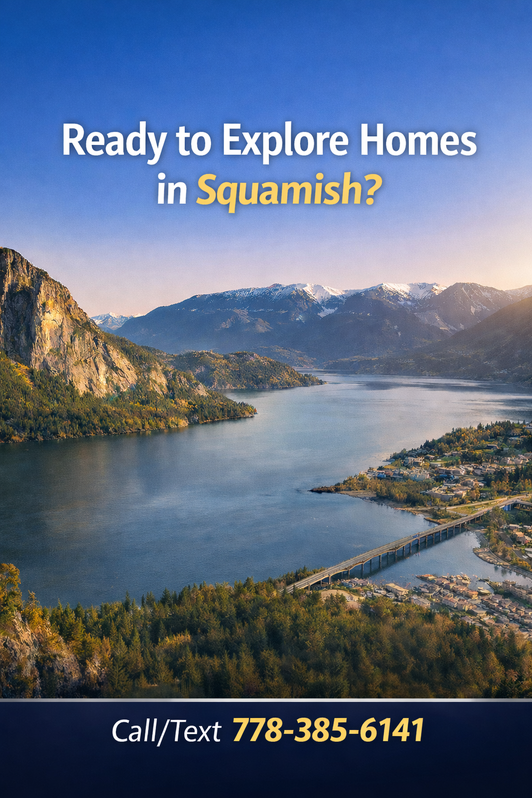
Squamish is located in southwestern British Columbia at the north end of Howe Sound, roughly 64 kilometers from downtown Vancouver.It sits in the Coast Mountains between Vancouver and Whistler. The Sea to Sky Highway connects these communities through one of the most scenic drives in Canada.The town sits along Howe Sound with the dramatic Coast Mountain peaks rising behind it, including the famous Stawamus Chief and the Garibaldi Range.
Squamish has earned the nickname Outdoor Recreation Capital of Canada thanks to its extensive trails, mountains, and waterways.
Why So Many People Are Moving to Squamish
Squamish experienced significant population growth over the last decade as many residents looked for more space and a lifestyle centered around nature. Key reasons include:Lifestyle
Squamish offers exceptional access to outdoor recreation, including hiking, climbing, mountain biking, windsurfing, fishing, and skiing.
Squamish offers exceptional access to outdoor recreation, including hiking, climbing, mountain biking, windsurfing, fishing, and skiing.
Natural Beauty
Few places combine mountains, ocean, and forest the way Squamish does.
Few places combine mountains, ocean, and forest the way Squamish does.
Quality of Life
Residents enjoy good schools, low crime, and a strong community atmosphere.
Residents enjoy good schools, low crime, and a strong community atmosphere.
Economic Growth
New housing development and business growth have increased job opportunities across construction, retail, tourism, and professional services.
New housing development and business growth have increased job opportunities across construction, retail, tourism, and professional services.
Because of these factors, Squamish has become popular with Vancouver commuters, remote workers, and people seeking a lifestyle change.
Squamish Real Estate Market Overview
Squamish real estate remains competitive but more balanced than in previous years.The typical benchmark home price sits around C$1.12 million.
Average property values vary depending on property type: Detached homes approximately C$1.7 million
Townhomes approximately C$1.0 million
Condos approximately C$560,000
Townhomes approximately C$1.0 million
Condos approximately C$560,000
Listings have gradually increased, giving buyers slightly more options. Homes priced appropriately often still receive strong interest.
New developments, including townhome communities and condo projects, are adding additional housing supply.
Cost of Living in Squamish, BC
The cost of living in Squamish is high compared with many Canadian towns, largely due to housing costs.Housing
One-bedroom apartments average roughly C$2,100 to C$2,300 per month.
Three-bedroom rentals can exceed C$4,000 monthly.
Three-bedroom rentals can exceed C$4,000 monthly.
Buying property is also expensive, with condos averaging roughly $700,000 depending on size and location.
Utilities
Basic utilities, including electricity, heat, and water, average around C$166 monthly.
Internet service averages about $85 per month.
Groceries and Dining
Prices are similar to Vancouver.
A midrange restaurant dinner may cost around $100 for two people.
Transportation
Many residents rely on cars since transit options are limited. Gas costs are typically higher in British Columbia than in many other provinces.
Overall, housing represents the largest expense for most residents.
Best Neighbourhoods in Squamish
Squamish offers several distinct neighborhoods.Downtown Squamish
The urban center with restaurants, shops, and condos. Walkable and convenient.Garibaldi Highlands
A prestigious residential area with larger homes, quiet streets, and mountain views.Valleycliffe
A popular family neighborhood with parks, schools, and relatively more affordable housing.Garibaldi Estates
Quiet residential area near the entrance to Squamish with many detached homes.Brackendale
A community known for eagle watching in winter and larger rural-style properties.Dentville
An emerging neighborhood with new townhomes and condos.Squamish Lifestyle and Outdoor Activities
Outdoor recreation defines life in Squamish.Hiking and Climbing
The Stawamus Chief and surrounding mountains offer incredible hiking and climbing opportunities.
Mountain Biking
Squamish is internationally known for its mountain biking trails.
Water Sports
Howe Sound provides ideal conditions for windsurfing and kiteboarding.
Winter Activities
Nearby ski resorts, including Whistler Blackcomb, provide excellent winter recreation.
Community Life
The town hosts ultramarathons, festivals, and farmers' markets throughout the year.
Squamish Weather and Climate Throughout the Year
Squamish has a mild oceanic climate.Rainfall
The town receives more than 2,000 mm of rain annually.
Winter
Temperatures typically hover around 4 degrees Celsius during the day.
Summer
Warm and pleasant with average highs around 24 to 25 degrees Celsius.
While winters can be wet, summers are sunny and comfortable.
Commuting From Squamish to Vancouver
Many residents in Squamish commute to Vancouver or the North Shore for work. The town has become increasingly popular with professionals who want a quieter lifestyle while still maintaining access to Metro Vancouver employment opportunities. Thanks to the Sea to Sky Highway, commuting is manageable, though it requires planning and flexibility.Driving
Driving is the most common commuting option. The Sea to Sky Highway connects Squamish directly to West Vancouver and downtown Vancouver. In ideal traffic conditions, the drive can take about 60 minutes. However, during peak commuting hours, travel times typically range between 75 and 90 minutes.Weather and traffic can impact travel times, particularly during winter months when rain, snow, or highway accidents occasionally slow traffic. Many residents adjust their schedules or work hybrid arrangements to avoid rush hour congestion. Living closer to the highway entrance in neighborhoods such as Garibaldi Estates can also help reduce commute times.
Bus Services
For those who prefer not to drive, several shuttle services provide transportation between Squamish and Vancouver. These services operate multiple times per day and connect Squamish with downtown Vancouver and Vancouver International Airport.Travel times usually range from 90 minutes to two hours depending on traffic conditions. These buses are popular with commuters, travelers heading to the airport, and visitors traveling to Whistler through the Sea to Sky corridor.Local Bus Services
Within Squamish itself, local bus routes help residents travel between neighborhoods, shopping areas, and schools. While the transit system is not as extensive as Vancouver’s, it does provide basic connectivity throughout the community.Most households still rely on cars for daily transportation, especially for commuting to work or traveling to nearby communities.Schools and Education in Squamish
Education is an important factor for families considering a move to Squamish. The community is served by the Squamish Lillooet School District, which provides a range of public education options for students from kindergarten through high school.The district operates several elementary schools throughout the town, along with a middle school and a secondary school that serves older students. These schools focus not only on traditional academics but also incorporate outdoor learning opportunities that reflect the region’s natural surroundings.
Private education options are also available, including Montessori and alternative learning programs. These schools offer smaller class sizes and specialized educational approaches that appeal to many families moving to the area.
Capilano University operates a campus in Squamish, offering postsecondary programs, university transfer courses, and continuing education opportunities. The campus has helped strengthen the local education ecosystem and provides opportunities for residents who want to pursue higher education without leaving the community.
Jobs and Economic Opportunities
Squamish has a growing local economy that continues to expand as the population increases. While the town is smaller than Vancouver, it offers a variety of employment opportunities across multiple industries.Key industries in Squamish include construction, tourism, retail, and professional services. Construction has seen strong growth due to the increasing demand for housing and new developments. Tourism is another major contributor to the local economy, as visitors travel to Squamish year-round for outdoor recreation and events.
Retail and hospitality businesses continue to expand in the downtown core, providing employment in restaurants, breweries, shops, and tourism-related services. Professional services, including engineering, consulting, and design firms, are also becoming more common as the local economy diversifies.
Despite this growth, many residents still commute to Vancouver or the North Shore for higher-paying professional jobs. Remote work has also become increasingly common, allowing professionals to live in Squamish while working for companies located in larger cities.
Pros of Living in Squamish
One of the biggest advantages of living in Squamish is the unparalleled access to outdoor recreation. Residents can step outside their door and immediately access hiking trails, mountain biking routes, climbing areas, and water sports opportunities.The community itself has a strong sense of identity and connection. Squamish maintains a small-town atmosphere where neighbors know each other and local events bring residents together throughout the year.
Families are drawn to the area because of the quality of schools and the abundance of parks and recreation facilities. Children grow up surrounded by nature and outdoor activities that encourage healthy and active lifestyles.
The real estate market has also experienced significant growth over the past decade. As more people discover Squamish, property values have generally increased, creating strong long-term investment potential for homeowners.
Another advantage is the coastal climate. Winters are milder compared to many other parts of Canada, and summers are warm but comfortable, making outdoor activities possible throughout the year.
Cons of Living in Squamish
Despite its many advantages, Squamish also has some drawbacks that potential residents should consider.Housing costs have risen significantly as demand for homes has increased. Buying a property in Squamish can be expensive, particularly for detached houses in desirable neighborhoods. Rent prices have also climbed as more people move to the area.
The commute to Vancouver is another factor. While manageable, the drive can be long and occasionally unpredictable due to weather conditions or traffic along the Sea to Sky Highway.
Squamish also has fewer big-city amenities compared to Vancouver. While the town has grocery stores, restaurants, and services, residents may still need to travel to Vancouver for specialized healthcare, major shopping centers, or large cultural events.
The weather is another consideration. Squamish receives significant rainfall throughout the year, particularly during the fall and winter months. For people who prefer dry climates and consistent sunshine, this can take some adjustment.
Squamish vs Vancouver
Comparing Squamish and Vancouver highlights two very different lifestyles.Squamish offers more living space, quieter neighborhoods, and immediate access to nature. Homes often include larger lots, mountain views, and proximity to outdoor recreation. For people who prioritize an active lifestyle, Squamish provides opportunities that are difficult to match in larger cities.
Vancouver, on the other hand, offers a broader job market, extensive public transit, and a vibrant urban environment with diverse cultural attractions, restaurants, and entertainment options.
Ultimately, choosing between Squamish and Vancouver comes down to personal priorities. Some people prefer the energy and convenience of city life, while others value the outdoor lifestyle and slower pace that Squamish provides.
Is Squamish a Good Place for Families?
Squamish has become an increasingly popular destination for families looking for a safe and supportive community. Neighborhoods are generally quiet and residential, with parks, playgrounds, and schools located throughout the town.Children growing up in Squamish benefit from constant exposure to nature. Hiking trails, lakes, rivers, and forests provide endless opportunities for exploration and outdoor activities.
Local recreation facilities offer swimming pools, ice rinks, sports fields, and community programs that support youth development and family activities.
Because of these factors, many families choose Squamish as a place where children can grow up with both strong educational opportunities and a healthy outdoor lifestyle.
Is Squamish a Good Place to Invest in Real Estate?
Squamish has attracted increasing attention from real estate investors over the past decade. The combination of population growth, limited land supply, and proximity to Vancouver has supported steady property value appreciation.As more buyers look for alternatives to expensive Vancouver real estate, Squamish continues to experience strong demand. This demand has helped maintain a competitive housing market even during periods of broader real estate uncertainty.
Investors often focus on family homes, townhouses, and rental properties that appeal to young professionals and families relocating to the region. Vacation-style properties can also perform well due to tourism and seasonal demand.
Like any real estate market, however, investment decisions should be made with a long-term perspective and careful research.
Future Growth and Development in Squamish
Squamish is actively planning for future growth as more people move to the community. The local government has introduced development plans aimed at increasing housing supply while maintaining the town’s unique character.New residential developments are being built to accommodate population growth, including townhomes, condominiums, and mixed-use communities. These developments are designed to support walkable neighborhoods with nearby shops and services.
Recreation facilities are also expanding to serve the growing population. Improvements to parks, sports fields, and community centers help maintain the quality of life that residents expect.
Waterfront redevelopment projects are transforming former industrial areas into vibrant residential and commercial spaces. These projects will add housing, retail spaces, and public parks along the shoreline.
Population projections suggest that Squamish could surpass 30,000 residents within the next decade, further strengthening the local economy and housing market.
Who Should Consider Moving to Squamish?
Squamish appeals to a wide range of people who are looking for a different lifestyle than what major cities offer.Outdoor enthusiasts are naturally drawn to the area because of the easy access to mountains, forests, and ocean recreation.
Families seeking more space often choose Squamish for its quieter neighborhoods, good schools, and strong community environment.
Remote workers have also discovered the benefits of living in Squamish. With modern technology and flexible work arrangements, many professionals can enjoy the lifestyle advantages of the area while still working for companies based in larger cities.
Lifestyle-focused buyers who value nature, community, and outdoor adventure frequently find that Squamish offers the perfect balance.Real estate investors also see opportunities due to the town’s continued growth and demand for housing.
However, individuals who require frequent access to Vancouver for work or entertainment should carefully consider the commute before relocating.
Thinking About Buying a Home in Squamish
If you are considering buying property in Squamish, it is important to explore different neighborhoods and understand current market conditions.Each area of Squamish offers a different lifestyle, from the walkable convenience of downtown to the quiet mountain views found in neighborhoods like Garibaldi Highlands.
Working with a knowledgeable local real estate professional can help buyers identify suitable properties, understand pricing trends, and navigate the competitive market.
A well-informed approach allows buyers to find the right home while making a sound long term investment in one of British Columbia’s fastest-growing communities.
Ready to Explore Homes in Squamish?
If you are considering living in Squamish, BC, or buying a home in the Sea to Sky region, having the right guidance can make all the difference.The Squamish real estate market moves quickly, and understanding local neighborhoods, pricing trends, and future developments is essential before making a decision.
Adam Chahl, founder of Vancouver Home Search and the PLACE Real Estate Team – Oakwyn Realty, has helped buyers and sellers navigate competitive markets across Greater Vancouver and surrounding communities.
Whether you are:
• Relocating from Vancouver
• Looking for a mountain lifestyle property
• Buying your first home in Squamish
• Searching for an investment property in the Sea to Sky corridor
• Buying your first home in Squamish
• Searching for an investment property in the Sea to Sky corridor
Adam and his team can help you evaluate opportunities and find the right property for your goals.
With deep market knowledge and a strong network across British Columbia, Adam provides buyers with the insights needed to make confident real estate decisions.
Contact Adam Chahl today to start exploring homes in Squamish and discover what opportunities are available in this fast-growing mountain community.