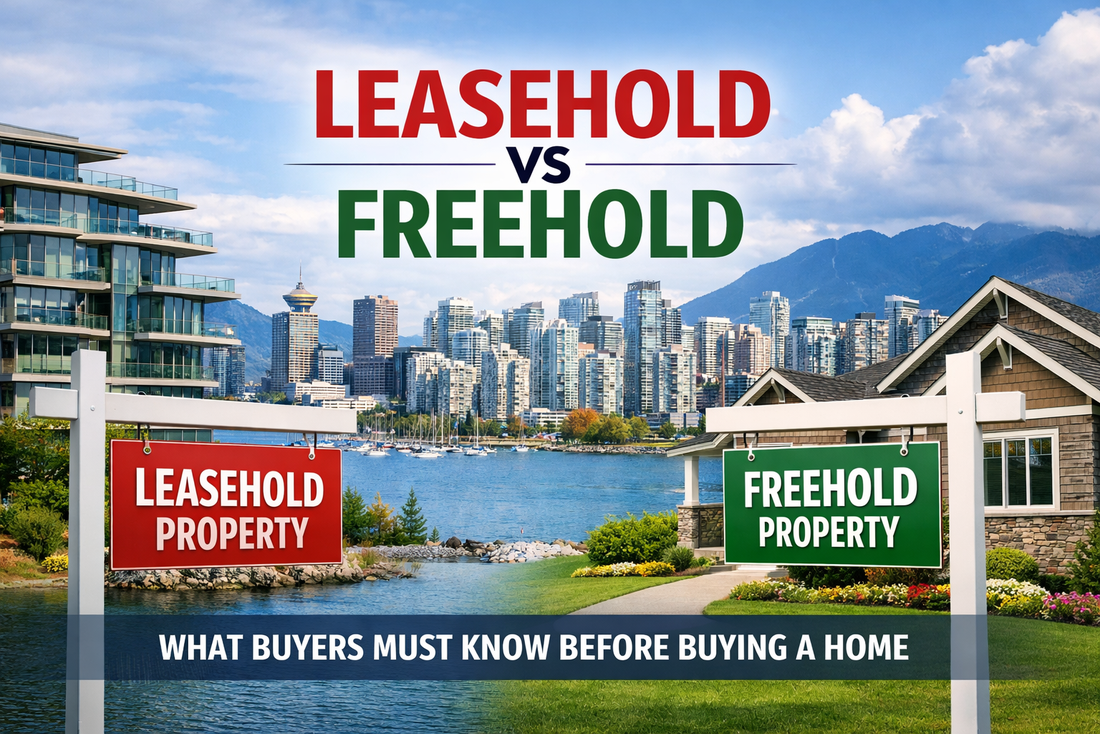
 Buying a home in Vancouver or Greater Vancouver is already a big decision. Add ownership type into the mix and things get confusing fast. One of the most common questions buyers ask is whether they should choose leasehold or freehold ownership.This guide breaks down leasehold vs. freehold Vancouver ownership in plain language. No jargon. No scare tactics. Just what buyers, investors, and downsizers need to know before committing to a purchase.Whether you are exploring first-time homebuyer Vancouver options, considering an investment, or downsizing for lifestyle reasons, understanding how ownership works is critical.
What Does Freehold Ownership Mean in Vancouver
A freehold property purchase in Vancouver means you own both the home and the land it sits on. There is no time limit on ownership. You can live in it, rent it, sell it, or pass it on to your family.This is the most common form of ownership across Vancouver, Burnaby, Richmond, Coquitlam, and most of the Lower Mainland.Key traits of freehold ownership in Vancouver
- You own the land and the structure
- Ownership does not expire
- No lease payments to a landowner
- Easier financing with most lenders
- Typically stronger long-term value growth
What Does Leasehold Ownership Mean in Vancouver
A leasehold property purchase in Vancouver means you own the home, but not the land underneath it. The land is leased from a landowner for a fixed period, often 60, 75, or 99 years.Common landowners include universities, the City of Vancouver, and First Nations.You are buying the right to live on the land for the remaining lease term.When the lease ends, ownership of the land returns fully to the landowner. What happens to the home depends on the lease terms.Key traits of leasehold real estate in Vancouver
- You do not own the land
- Ownership is time-limited
- Purchase prices are usually lower
- Financing rules are stricter
- Resale depends heavily on remaining lease length
Leasehold vs Freehold Vancouver: The Real Differences
The difference is not lifestyle. It is a risk, a timeline, and a long-term value.Ownership length
Freehold ownership lasts foreverLeasehold ownership ends when the lease expires
Price
Leasehold homes are often priced 10 to 30 percent lower than comparable freehold homesFreehold homes cost more because land value is included
Financing
Freehold properties are easy for banks to financeLeasehold properties often require larger down payments and shorter mortgage termsMost lenders will not offer a mortgage that extends beyond the lease end date.
Resale
Freehold homes appeal to nearly all buyersLeasehold homes appeal to a smaller buyer poolAs leases shorten, resale becomes harder.
Value growth
Freehold ownership in Vancouver benefits fully from land appreciationLeasehold properties may rise in value, but the lease limits long term gainsThis is why understanding leasehold vs freehold in Vancouver matters before you buy.
Vancouver Leasehold Pros and Cons
Leasehold properties are not good or bad by default. They are situational.Pros of Leasehold Property in Vancouver
- Lower purchase price
- Access to prime locations
- Less competition when buying
- Can make ownership possible for first-time buyers
- Works well for buyers with a defined time horizon
Cons and risks of leasehold property in Vancouver
- The lease expires
- Financing can be difficult
- Resale becomes harder as time passes
- Lease payments may increase
- No long-term land appreciation
Freehold Ownership Vancouver: Pros and Cons
Freehold ownership is simpler but more expensive.Pros of freehold property in Vancouver
- Permanent ownership
- Strong resale demand
- Easier financing
- No lease payments
- Better long-term wealth building
Cons of freehold ownership
- Higher purchase price
- Higher down payment required
- More competition in hot markets
Leasehold Properties in Greater Vancouver: Real Examples
Leasehold ownership is concentrated in specific areas.Vancouver West and UBC
Many homes around UBC sit on long-term prepaid leases. These leases often run close to 100 years, making them feel similar to freehold for current owners.Prices are typically lower than those of freehold homes nearby, which attracts families, downsizers, and investors.Burnaby and SFU
Homes near SFU are often leasehold. These are long-term leases and are popular with buyers who value location and price over permanent land ownership.False Creek South
This is one of the most well-known leasehold areas in Vancouver. Many leases here are approaching expiry, which has affected pricing and buyer confidence.It is a clear example of why lease length matters.Richmond leasehold condos
Richmond has several older leasehold condo developments. Prices are often far lower than freehold condos, making them attractive to budget-conscious buyers and investors.Always confirm whether the lease is prepaid and how long it remains.Tsawwassen First Nation lands
Large master-planned communities have been built on long-term leases. These properties often offer newer homes at lower prices compared to nearby freehold options.They work well for buyers who plan to stay for decades, not generations.Who Should Consider Buying a Leasehold Property in Vancouver
First-time home buyers
Leasehold can be one of the few realistic first-time home buyer Vancouver options left in some areas.It works best when:- The lease has many decades remaining
- The buyer plans to sell well before expiry
- Financing has been confirmed in advance
Investors
Leasehold real estate in Vancouver can work for investors focused on cash flow rather than long-term land appreciation.The key is aligning the investment timeline with the lease length.Leasehold is not ideal for buy-and-hold-forever strategies.Downsizers
Leasehold properties often appeal to downsizers who:- Want a specific location
- Do not need permanent ownership
- Prefer a lower purchase price
- Plan to stay for a defined stage of life
Who Should Avoid Leasehold Ownership
Leasehold is usually not a good fit if:- You want to leave property to children
- You plan to hold for multiple generations
- You are highly risk-averse
- You need maximum resale flexibility
How Lease Length Affects Value and Financing
This is critical.Leaseholds with more than 70 to 80 years remaining tend to behave more like freeholds in the market.Leaseholds under 40 years often face:- Sharp value drops
- Limited financing options
- Cash buyer requirements
Making the Right Choice Between Leasehold and Freehold
There is no universal right answer.The right choice depends on:- Your budget
- Your timeline
- Your risk tolerance
- Your long-term plans