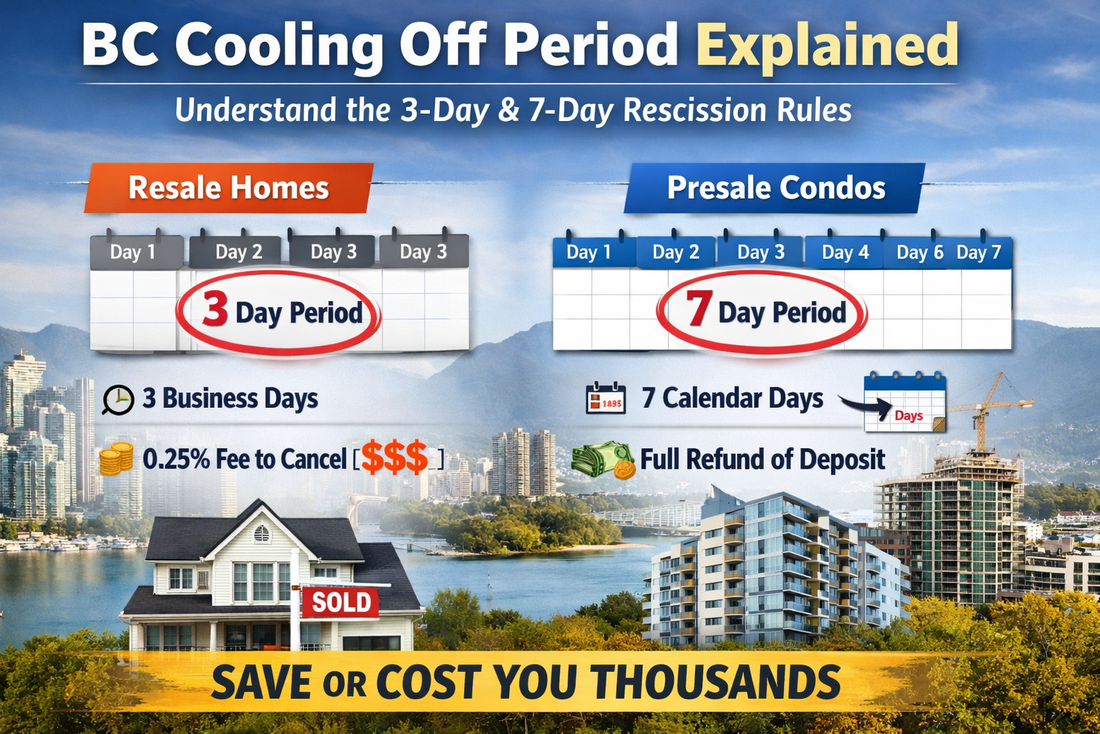
 Buying a home in British Columbia can be exciting and stressful, especially in a hot market where decisions are made in minutes. To protect buyers from rushed decisions, BC introduced new real estate rescission rules that create a short “cooling off” window. These rules give home buyers a brief timeframe to cancel a purchase after an offer is accepted. In this post, we’ll break down the BC cooling-off period real estate rules, including the three-day rescission period BC for most home purchases and the seven-day rescission presale condo BC rule for presales. We’ll use simple language, real transaction examples from BC, and official government guidance to explain how these cancellation rights work and how they can save you money or cost you money if you misunderstand them. Whether you’re buying a resale home or a presale condo, understanding these windows matters. Being blind to them can cost tens of thousands.
What is a Cooling Off Period in BC Real Estate
A cooling-off period, also called a rescission period, is a short timeframe after a real estate contract is formed where the buyer can back out with limited penalty. In BC cooling-off period real estate terms, the main change was the launch of the Home Buyer Rescission Period in early 2023. Effective January 3, 2023, BC implemented a mandatory cooling-off period home purchase BC rule for many residential resale transactions. This gives buyers three business days to cancel an accepted offer. BC also has a separate presale condo cooling-off period BC rule that gives buyers seven days to cancel most presale contracts under development marketing rules.Why did BC do this? People were making fast, subject-free offers during multiple offer situations. Some buyers later regretted the purchase or faced financing issues after the fact. The cooling-off period was introduced to give buyers a short pause to confirm they are comfortable, secure financing, and rethink the decision before they are fully locked in.Now let’s break down what the 3-day rescission means in practice, what it costs, and where people get burned.The 3 Day Home Buyer Rescission Period for Resale Homes
How the Three-Day Rescission Period Works in BC
BC’s Home Buyer Rescission Period gives buyers three business days after an offer is accepted to cancel the contract for any reason. Business days exclude weekends and statutory holidays. The clock starts the next business day after final acceptance.Example of timingIf a seller accepts your offer on a Friday, the rescission period typically runs through Monday, Tuesday, and Wednesday, then expires at 11:59 p.m. Wednesday night, assuming no holiday.This rescission right cannot be waived. Even if both parties wanted to skip it, the law makes it mandatory for eligible transactions.To use this right, the buyer must provide written notice of cancellation to the seller or the seller’s agent before the deadline expires. No explanation is required.However, canceling is not free. The buyer must pay the seller a rescission fee equal to 0.25 percent of the purchase price.Examples of the rescission fee
A 1,000,000 purchase equals a 2,500 fee
A 500,000 purchase equals a 1,250 fee
A 2,000,000 purchase equals a 5,000 fee
This fee is usually deducted from the buyer’s deposit. If the buyer has not paid a deposit yet, they still owe the rescission fee.
Key points of the three-day rescission period BC
Applies to
Most residential resale purchases in BC
Length
3 business days from the next business day after acceptance
3 business days from the next business day after acceptance
Who can cancel
Only the buyer, for any reason
Only the buyer, for any reason
Notification
Written notice must be delivered before the deadline
Written notice must be delivered before the deadline
Cost
0.25 percent of the purchase price paid to the seller
0.25 percent of the purchase price paid to the seller
Cannot be waived
Mandatory for eligible transactions
You make a subject-free offer on a Vancouver house for 1,200,000 in a multiple offer situation and win. The next day you realize you stretched too far or feel you overpaid. You cancel within the rescission window. You pay 3,000 to the seller. It hurts, but you exit a deal you did not truly want, potentially saving yourself from a much bigger mistake.
Mandatory for eligible transactions
Real World Examples: The 3 Day Cooling-Off Period in Action
Example 1: Backing out and paying the feeYou make a subject-free offer on a Vancouver house for 1,200,000 in a multiple offer situation and win. The next day you realize you stretched too far or feel you overpaid. You cancel within the rescission window. You pay 3,000 to the seller. It hurts, but you exit a deal you did not truly want, potentially saving yourself from a much bigger mistake.
Example 2: A real BC lesson on why timing matters
There are BC cases where buyers walked away after signing and later faced massive consequences because they were outside any legal cancellation window. In one well-known BC court dispute, a buyer walked away from a multimillion-dollar purchase. The seller later resold for far less and pursued damages. The buyer’s liability became enormous compared to what a small capped rescission fee would have been if such a right had been available and used within the allowed timeframe. The point is simple. If you change your mind early, the law can cap the damage. If you change your mind late, the damage can become unpredictable and brutal.
There are BC cases where buyers walked away after signing and later faced massive consequences because they were outside any legal cancellation window. In one well-known BC court dispute, a buyer walked away from a multimillion-dollar purchase. The seller later resold for far less and pursued damages. The buyer’s liability became enormous compared to what a small capped rescission fee would have been if such a right had been available and used within the allowed timeframe. The point is simple. If you change your mind early, the law can cap the damage. If you change your mind late, the damage can become unpredictable and brutal.
Example 3: The common misunderstanding about inspections
Some buyers assume the cooling-off period means they can do an inspection in those three days. Not necessarily. Unless your contract gives you inspection access, the seller is not required to let you back in. That means the rescission window may only give you time to think, talk to your lender, talk to your lawyer, and review documents you already have. It may not create new access to the property.
Some buyers assume the cooling-off period means they can do an inspection in those three days. Not necessarily. Unless your contract gives you inspection access, the seller is not required to let you back in. That means the rescission window may only give you time to think, talk to your lender, talk to your lawyer, and review documents you already have. It may not create new access to the property.
Limitations and Pitfalls of the 3 Day Rescission Rule
There are three major traps.Trap 1: The window is short
Three business days can disappear fast. If you uncover a problem on day four, the rescission right is gone.
Three business days can disappear fast. If you uncover a problem on day four, the rescission right is gone.
Trap 2: The rescission fee is real money
On a Vancouver purchase price, the fee is often in the thousands. You do not get it back. Treat it as emergency insurance, not a shopping tool.
On a Vancouver purchase price, the fee is often in the thousands. You do not get it back. Treat it as emergency insurance, not a shopping tool.
Trap 3: You may not be able to do full due diligence inside the window
No contract condition means no guaranteed inspection access. You might not be able to reenter the home. You might not be able to schedule specialists.
No contract condition means no guaranteed inspection access. You might not be able to reenter the home. You might not be able to schedule specialists.
You might not even get clear answers from a strata in time if documents are delayed.This is why the cooling-off period is not a replacement for smart conditions when conditions are possible. It is a backstop for the moments when you have to move fast.
The 7 Day Rescission Period for Presale Condos in BC
Buying a presale condo is different from buying a resale home. Presales in BC have long included a seven day rescission presale condo BC rules. This gives buyers a full week to cancel after receiving the proper disclosure materials and entering the contract.How the Seven-Day Presale Condo Rescission Works
Here is what matters.When it starts
The seven-day clock generally begins once the buyer has both a signed contract and has received the developer disclosure statement, and acknowledged receipt.
The seven-day clock generally begins once the buyer has both a signed contract and has received the developer disclosure statement, and acknowledged receipt.
How long does it lasts
7 calendar days. Weekends count.
7 calendar days. Weekends count.
Who can cancel
Only the buyer, for any reason.
Only the buyer, for any reason.
Cost
No penalty in the standard rescission window.
No penalty in the standard rescission window.
The buyer should receive a full return of the deposit if they cancel properly within the timeframe.
How cancellation happens
Written notice delivered to the developer before the deadline.
Written notice delivered to the developer before the deadline.
One crucial difference from many resale deals
If you do nothing, the presale contract usually continues.
If you do nothing, the presale contract usually continues.
There is no need to “remove subjects” to make it firm. Silence typically means you are proceeding.
3 day rescission period applies to most resale purchases
7-day rescission applies to presale purchases from a developer.
Comparing the 3 Day and 7 Day Rescission Rules
Both are cooling-off protections, but they function differently. What they apply to3 day rescission period applies to most resale purchases
7-day rescission applies to presale purchases from a developer.
How long do you get
3 business days versus 7 calendar days
What it costs to cancel
Resale rescission costs 0.25 percent of the purchase price
Presale rescission typically has no fee during the rescission window
Resale rescission costs 0.25 percent of the purchase price
Presale rescission typically has no fee during the rescission window
What triggers the clock
Resale starts right after acceptance
Presale starts after the contract, plus disclosure delivery and acknowledgment
Resale starts right after acceptance
Presale starts after the contract, plus disclosure delivery and acknowledgment
If you are buying a presale condo, the presale condo cooling-off period BC is often a more forgiving window than the resale rule, but you still need to track the deadline carefully.
Review any documents you already have, including strata docs if it is a condo
Decide early if something feels wrong, because waiting costs you your rescission option
A right to cancel many resale purchases within three business days, with a 0.25 percent fee
A right to cancel many presale purchases within seven days, often with no penalty
Do your homework before you sign, use conditions when you can, and treat rescission as a backstop.
How Cooling Off Periods Can Save You Thousands
When used correctly, these rules can save you in very real ways.Saving you from a bad purchase decision
If you realize you overcommitted, misjudged monthly costs, or spotted a serious issue early, rescission can be the cheapest exit you will ever get.Saving your deposit
Before these rules, backing out after acceptance could put your full deposit at risk, and sometimes more. With the rescission option, your loss can be limited to the rescission fee on resale deals, and often zero on presales if you cancel in time.Saving you from financing fallout
Rates move. Appraisals come in low. Lenders sometimes change their view when they review the full file. If you went subject-free and financing suddenly looks shaky, the three-day rescission period BC can be a last chance to avoid a bigger problem.Saving you from future costs you did not anticipate
This shows up most in condos. Strata fees, upcoming major projects, special levies, and insurance changes can hit hard. If you get new information during your cooling-off window, rescission may protect you from taking on costs you did not budget for.How These Rules Can Cost You
Cooling-off periods can also cost you money, especially if you treat them casually.The rescission fee is not a rounding error
If you cancel a 1,500,000 purchase, you lose 3,750. For many buyers, that is serious money. It is also money you will never recover.You may still be exposed if you waive conditions
This is the big one. The rescission period is short. Financing often takes longer than three business days. Inspections can be hard to schedule. Specialists may not be available fast. If you waive conditions and assume rescission covers you, you might run out of time.This is the core of the risks of waiving conditions in BC real estate. You can end up stuck with a contract that you cannot fund or a home with issues you did not uncover early enough.Sellers and the market impact
Sellers can lose time and momentum if a buyer rescinds. A listing can appear sold, then come back. Other buyers wonder what happened. It can create doubt, and sometimes it can impact price. Even with the fee, a seller can still be worse off if the next offer is lower.Practical Playbook: How Buyers Should Use the Cooling Off Period
If you are a buyer, here is the clean approach.Step 1: Treat your offer as real from the start
Do not write offers hoping to decide later. Even with rescission, canceling can cost you thousands. Make your decision before you sign.Step 2: Use conditions when the market allows
If you can, use an inspection condition and a financing condition. That gives you a longer window and often a penalty-free exit if something does not check out. The rescission period is not a full substitute for these.Step 3: If you must go subject-free, plan your first 72 hours
If you are in a multiple offer situation and went subject-free, you should immediately do three things: Call your lender or broker to confirm approval stepsReview any documents you already have, including strata docs if it is a condo
Decide early if something feels wrong, because waiting costs you your rescission option
Step 4: Understand the real question buyers ask
Most people eventually ask some version of this: Can I cancel a home purchase in BC if I panic or discover something? Yes, but only inside the rules. After that, it gets expensive fast.FAQ: BC Cooling Off Periods
Can I cancel a home purchase in BC after an offer is accepted
Yes. In many resale transactions, you can cancel during the buying a home in BC cooling off period window, which is typically three business days from the next business day after acceptance. You must give written notice and pay the rescission fee equal to 0.25 percent of the purchase price. If you are buying a presale, you usually have seven days to cancel with no penalty if you follow the presale rescission rules.What are BC home buyer cancellation rights under these rules
Your BC home buyer cancellation rights generally includeA right to cancel many resale purchases within three business days, with a 0.25 percent fee
A right to cancel many presale purchases within seven days, often with no penalty
Does the cooling-off period apply to every purchase
No. Some special sale types can be exempt. Presales follow their own seven-day rule. Certain unusual sale formats can fall outside the resale rescission regulation. Your agent and lawyer should confirm whether your specific purchase is covered.If I rescind, do I lose my deposit
In a resale rescission, you generally lose only the rescission fee amount, and the remainder of your deposit should be returned. In a presale rescission within seven days, the deposit is typically returned in full.What is the biggest mistake buyers make with rescission
Assuming it replaces real due diligence. The rescission window is short and may not guarantee access for inspections if your contract does not provide it. The safest mindset is thisDo your homework before you sign, use conditions when you can, and treat rescission as a backstop.